Vhs - Kids & Family: Vhs Kids & Family Movies
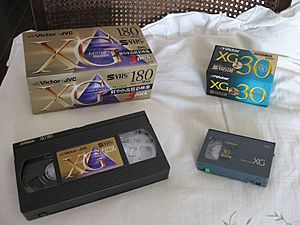
Full-size VHS tapes (left) and meaty VHS-C tapes (right)
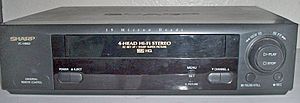
VHS ways Video Home System. This system uses a videocassette tape to record video and sound, which can be watched on a television. A DVD/VHS combo can record (write) on VHS tapes, read off VHS tapes, and additionally, read from DVD discs. A few can also record on DVD. VHS was and so popular that during the 1990s, the terms "videocassette", "videotape", or even just "video" usually referred to the VHS format.
VHS cassettes can be recorded using a video camera. They can likewise be recorded with a videocassette recorder, or VCR. A VCR can utilise a VHS cassette to record circulate tv set.
This organization was created in 1976 by the Victor Company of Japan (likewise called JVC). VHS was a very popular way for people to record and play video at dwelling house in the 1980s and 1990s, simply now DVD (Digital Versatile Disc) and Blu-ray take become more popular every bit they can be easier to use, the quality is higher, they terminal longer, and the discs and players are cheaper to make. VHS VCRs, as well as blank tapes and pre-recorded VHS movies, are no longer made, except for a few contained films. Blank tapes are still widely available equally new former stock.
Contents
- History
- Earlier VHS
- VHS development
- Variants
- Images for kids
History
Before VHS
Many companies developed different systems for recording video on a record cassette, only the outset VTR (short for Video Tape Recorder) to go popular and brand coin was the Ampex VRX-1000, which was introduced in 1956 by Ampex Corporation. It cost US$fifty,000 in 1956 (over $400,000 in 2016 money), and U.s.a.$300 (over $2,000 in 2016 money) for a 90-infinitesimal reel of tape. Because it was and so expensive, information technology was made and sold only for professional recording.
While Kenjiro Takayanagi, a television dissemination pioneer, was the vice president of JVC, he decided that his company could make money by developing and selling VTRs in Japan, and at a lower price. In 1959, JVC developed a two-caput video tape recorder, and by 1960 they had a color television version for professional dissemination. In 1964, JVC released the DV220. It would be the company'southward standard VTR until the mid-1970s.
In 1969, JVC worked with Sony Corporation and Matsushita Electric (who owned Panasonic) to blueprint a video recording technical standard for Japanese consumers. They developed the U-matic tape format in 1971, which was the first format to become a technical standard for VTRs. The U-matic format was successful in business and some video broadcasting. Still, few people bought U-matic VTRs to use at home because they were still very expensive, and the tapes could only record brusque time periods of video.
Soon later on, Sony and Matsushita stopped working on the projection. They started to work on their own video recording formats. Sony started working on Betamax and Matsushita started working on VX. JVC released the CR-6060 in 1975, which was based on the U-matic format. Sony and Matsushita also produced their own U-matic machines.
VHS development
In 1971, JVC engineers named Yuma Shiraishi and Shizuo Takano started a squad to develop a VTR for people to use at home. By the stop of 1971, they created an diagram titled "VHS Evolution Matrix", which listed goals for JVC's new VTR.
- The automobile must work with any ordinary television set.
- The picture on the television must resemble a normal television circulate.
- The tape must be able to tape at least 2 hours of video.
- The tapes must be able to record and play video on other machines of the same kind.
- The whole arrangement should be able to be expanded. For example, in that location should be ways to connect a video camera to the machine, and to record video from another recorder.
- Recorders should exist cheap, like shooting fish in a barrel to utilise and inexpensive to fix.
- The company must be able to produce large numbers of the machines, using interchangeable parts (in other words, different models and styles of car have the aforementioned parts inside).
In 1972, video recording industry in Nihon started to lose money. JVC had to find means to spend less money, so it stopped developing the VHS project. However, Takano and Shiraishi continued to work on the project by themselves, even though the company was not giving them any money to use. By 1973, the two engineers had built a epitome.
Variants
- VHS HQ (Loftier Quality) adds x extra lines of horizontal resolution, and is playback-uniform on non-HQ equipment.
- Linear stereo audio places two audio tracks in the space formerly used for the single mono audio track.
- VHS Hi-FI adds college-quality (near CD quality) stereo sound to VHS. It is backward compatible with standard VHS. A VCR without HI-FI capability volition simply play the tape in mono or linear stereo.
- VHS-C is a smaller version of the VHS cassette. It was typically used in camcorders. The tape inside is the same as in a full-size VHS cassette. A VHS-C cassette tin be played and recorded in a total-size VHS VCR with an adapter. Capacity is typically 30 minutes in SP mode. Tapes longer than thirty minutes be but are rare.
- Super VHS (S-VHS) is an improved version of VHS with a higher-quality movie. It is not astern-compatible with standard VHS. The picture quality is similar to Laserdisc or DVD. Playing an S-VHS tape on a standard VHS VCR will produce a heavily distorted picture show. There is also a smaller version of S-VHS for camcorders, called Due south-VHS-C.
- D-VHS (Information VHS or Digital VHS) is a digital variant that can record in high definition 720p or 1080i, and tin besides be used as a backup record for general-purpose data. Video quality and data chapters are similar to Blu-ray.
- W-VHS is an analog high-definition format. It records in 1035i.
- Digital-S or D-9 is a digital VHS variant designed for broadcasting, news gathering, or other professional person use. Information technology uses the DV codec and has a different record formulation than standard VHS cassettes.
Images for kids
-
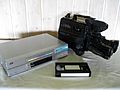
VHS recorder, camcorder and cassette.
-
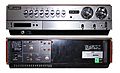
JVC HR-3300U VIDSTAR – the United States version of the JVC HR-3300. Information technology is virtually identical to the Japan version. Nihon's version showed the "Victor" proper noun, and didn't use the "VIDSTAR" proper name.
-
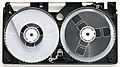
Tiptop view of VHS with front end casing removed
-

The interior of a modern VHS VCR showing the drum and tape.
-
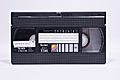
VHS cassette with time scale for SP and LP
-

Panasonic How-do-you-do-Fi six-head drum VEH0548 installed on One thousand mechanism as an case, demonstrated a typical VHS head pulsate containing two record heads. (ane) is the upper caput, (two) is the tape heads, and (3) is the head amplifier.
-

Shut-upwards of a head flake
-
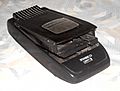
A record rewinder.
-
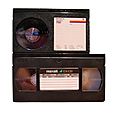
Size comparison between Betamax (top) and VHS (bottom) videocassettes.
-

A Rasputin Music retailer (Fresno, California) selling used VHS cassettes from l¢ to $1.98 each for people who nonetheless take working VCRs.
-

A badly molded VHS tape. Mold can prevent modern apply. Run into Media preservation.

All content from Kiddle encyclopedia articles (including the commodity images and facts) can exist freely used under Attribution-ShareAlike license, unless stated otherwise. Cite this article:
VHS Facts for Kids. Kiddle Encyclopedia.
Source: https://kids.kiddle.co/VHS
0 Response to "Vhs - Kids & Family: Vhs Kids & Family Movies"
Post a Comment